|
Invited Topics
- Predator-Based IPM: Functional Responses and Conservation
Strategies
- Entomopathogenic Fungi as Biocontrol Agents: Biology,
Formulation, and Use
- Entomopathogenic Nematodes: Application Technology and Field
Success Factors
- Bacillus thuringiensis in Crop Protection: Efficacy,
Resistance, and Safety
- Viral Biopesticides: NPV and GV in Sustainable Pest
Management
- Microbial Consortia and Biopesticide Innovations:
Opportunities and Constraints
- Botanical Insecticides in IPM: Chemistry, Efficacy, and
Standardization
- Neem-Based Insect Management: Modes of Action and Field
Protocols
- Plant-Derived Repellents and Antifeedants: Evidence and
Practical Use
- Semiochemicals in Pest Management: Principles and Crop
Applications
- Pheromone Traps for Monitoring: Design, Placement, and
Interpretation
- Mating Disruption Technologies: Strategies, Limitations, and
Case Studies
- Mass Trapping Systems: Optimization and Area-Wide
Implementation
- Push–Pull Pest Management: Ecological Basis and Adaptation
for Crops
- Trap Cropping: Design, Timing, and Landscape Integration
- Cultural Control Practices: Sowing Time, Crop Rotation, and
Sanitation
- Mechanical and Physical Control: Barriers, Nets, and
Exclusion Methods
- Protected Cultivation Entomology: Pest Dynamics Under
Greenhouse Systems
- Insect Pests in Polyhouse and Net-House Crops: Monitoring
and Control
- Stored Product Entomology: Key Pests and Integrated Storage
Protection
- Post-Harvest Pest Management: Safe Methods and Loss
Reduction
- Insecticide Resistance: Evolution, Mechanisms, and Detection
Tools
- Resistance Monitoring Programs: Field Protocols and Data
Interpretation
- Insecticide Resistance Management: Rotations, Mixtures, and
Refugia
- Selective Insecticides and Non-Target Safety: Choosing
IPM-Compatible Chemistries
- Pesticide Risk Assessment in Agroecosystems: Pollinators and
Natural Enemies
- Pollinator-Safe Pest Management: Timing, Products, and
Communication
- Managing Secondary Pest Outbreaks: Causes and Preventive
Strategies
- Compatibility of Biocontrol Agents With Pesticides: Testing
and Guidelines
- Insecticide Residues and Food Safety: Standards, Monitoring,
and Mitigation
- Precision Pest Management: Concepts, Tools, and Adoption
Pathways
- Digital Tools for IPM: Decision Support Systems and Mobile
Apps
- Remote Sensing for Pest Detection: Methods, Accuracy, and
Field Deployment
- Drone-Based Pest Scouting: Workflows, Sensors, and Practical
Constraints
- AI and Machine Vision for Insect Identification: Datasets,
Models, and Validation
- Acoustic and Smart Trap Monitoring: Automation in Pest
Surveillance
- Spatial Ecology of Pests: Mapping Hotspots and Targeted
Interventions
- Landscape-Level IPM: Habitat Connectivity, Refuge Design,
and Outcomes
- Area-Wide Pest Management: Principles, Governance, and
Success Factors
- Biological Control in Area-Wide Programs: Coordination and
Quality Control
- Farmer Field Schools for IPM: Learning Models and Impact
Assessment
- Participatory Pest Management: Farmer Knowledge and
Co-Design Approaches
- Gender and Social Dimensions of IPM Adoption: Barriers and
Enablers
- Economics of Sustainable Pest Management: Costs, Benefits,
and Risk
- IPM in Smallholder Systems: Constraints, Adaptations, and
Case Examples
- IPM in Commercial Agriculture: Certification, Compliance,
and Scaling
- Organic Farming Entomology: Standards, Inputs, and Pest
Challenges
- Soil Health and Pest Regulation: Links Between Soil Biota
and Insects
- Plant Nutrition and Insect Pest Pressure: Mechanisms and
Management
- Water Stress and Pest Incidence: Physiological Links and
Field Evidence
- Interactions Between Insects and Plant Diseases: Vectors and
Complexes
- Integrated Management of Insect Vectors: Viruses, Bacteria,
and Phytoplasmas
- Whiteflies, Aphids, and Thrips: Biology, Damage, and
Integrated Control
- Stem Borers and Root Feeders: Detection and Control
Strategies
- Defoliators and Chewing Pests: Thresholds and Biocontrol
Options
- Sucking Pest Management in Cotton Systems: Integrated
Strategies
- Pest Management in Rice Ecosystems: Ecological Approaches
and Case Studies
- Maize Pest Complex Management: Fall Armyworm and Beyond
- Horticultural Pest Management: Fruit Borers, Leaf Miners,
and Mites
- Pest Management in Pulses and Oilseeds: IPM Packages and Outcomes
- Managing Soil-Dwelling Insects: Monitoring and Control
Technologies
- Stored Grain Protection: Hermetic Storage and Non-Chemical
Approaches
- Integrated Rodent and Insect Management in Storage Systems
- Emerging Biotechnologies in Entomology: RNAi and Gene
Editing Concepts
- RNAi-Based Pest Management: Delivery Systems and
Environmental Safety
- Genetically Engineered Crops: Bt Traits, Stewardship, and
Resistance
- Resistance Evolution in Bt Crops: Refugia Compliance and
Monitoring
- Sterile Insect Technique: Applications, Logistics, and
Sustainability
- Gene Drives in Pest Management: Potential, Ethics, and
Governance
- Ecological Risk of Novel Pest Technologies: Assessment
Frameworks
- Biodiversity-Friendly Pest Control: Metrics and Field
Approaches
- Climate-Smart IPM: Resilient Strategies for Variable Weather
- IPM Policy and Regulation: National Frameworks and
Implementation
- Pesticide Regulation and Registration: Data Needs and
Compliance
- Extension Strategies for IPM: Communication, Demonstration,
and Scale-Up
- Knowledge Translation in Entomology: From Research to Farmer
Practice
- Monitoring and Evaluation of IPM Programs: Indicators and
Methods
- Building Sustainable Pest Management Value Chains: Inputs,
Quality, and Trust
- Future Frontiers in Agricultural Entomology: Digital,
Biological, and Ecological Innovations
- Roadmap for Sustainable Crop Protection: Integrating
Ecology, Technology, and Policy
|
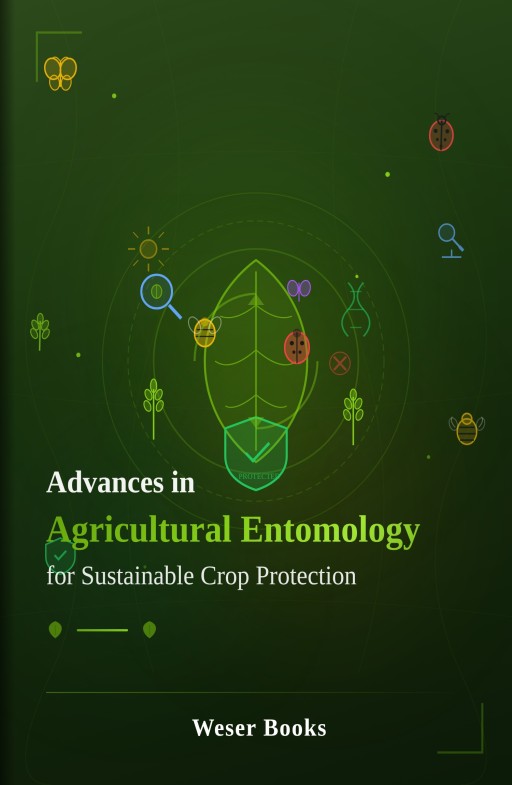
Book Scope
- Insect Pest Identification
- Pest Surveillance Methods
- Economic Threshold Levels
- Crop Pest Forecasting
- Insect Population Dynamics
- Pest Outbreak Ecology
- Climate Change and Pests
- Invasive Pest Management
- Host Plant Resistance
- Pest–Plant Interactions
- Insect Feeding Behavior
- Insect Life Cycles
- Insect Biodiversity in Farms
- Beneficial Insects in Agroecosystems
- Pollinator Health Management
- Conservation Biological Control
- Augmentative Biocontrol
- Parasitoids in IPM
- Predators in IPM
- Microbial Biopesticides
- Entomopathogenic Fungi
- Entomopathogenic Nematodes
- Bacillus thuringiensis Applications
- Botanical Insecticides
- Neem-Based Products
- Semiochemicals and Pheromones
- Mating Disruption Techniques
- Mass Trapping Strategies
- Push–Pull Systems
- Trap Cropping Approaches
- Cultural Pest Management
- Mechanical Control Methods
- Physical Barriers and Nets
- Protected Cultivation Pests
- Stored Grain Insect Pests
- Post-Harvest Pest Control
- Insecticide Resistance Monitoring
- Resistance Management Strategies
- Pesticide Risk Assessment
- Insecticide Residue Management
- Pollinator-Safe Spraying
- Precision Pest Management
- Drone-Based Pest Scouting
- Remote Sensing for Pests
- Digital IPM Decision Support
- Farmer Field Schools in IPM
- Community-Based Pest Management
- Pest Management Economics
- IPM Policy and Regulation
- Future Trends in Agricultural Entomology
Author Guidelines
To download guidelines: Click here
Submit Chapter
To submit chapter: Click here
OR
Send your chapter on weserbooks@gmail.com
Deadline
31th Jan 2026
|

 978-3-96492-721-7